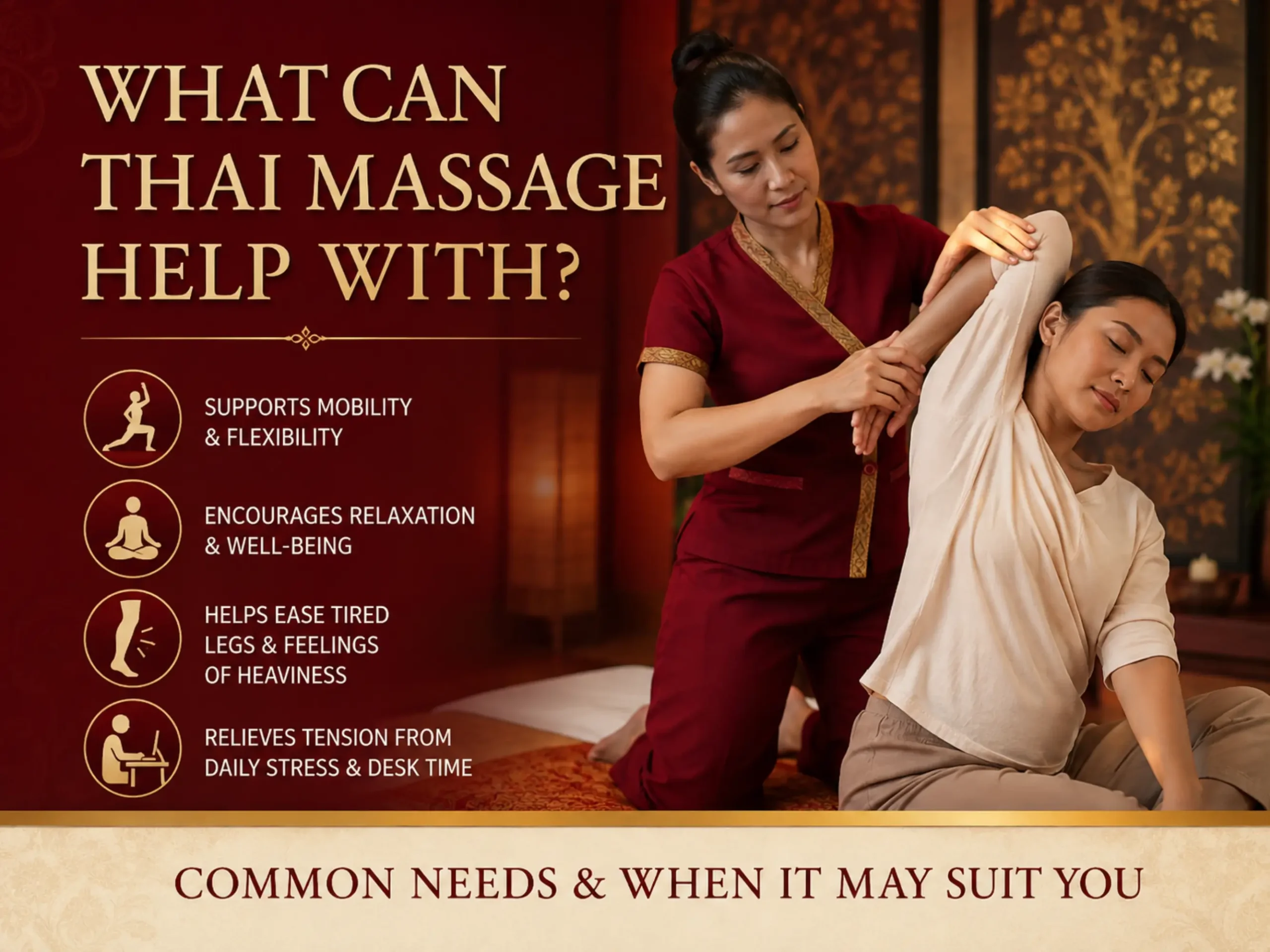
Thai massage may help some people feel more relaxed, experience less muscle tightness, and move more comfortably in the short term, especially when fatigue or stiffness is related to sitting for long periods, staying in the same position, walking a lot, standing for extended periods, or traveling for a long time. However, results vary from person to person, and Thai massage should not be presented as a treatment that can cure diseases or address the underlying cause of every symptom.
This article focuses specifically on potential benefits, available evidence, limitations of the evidence, and important precautions. If you would like to learn about the history, techniques, massage styles, and detailed procedures, see What Is Thai Massage?
Table of Contents
Summary of the Potential Benefits of Thai Massage
| Potential Benefit | What You Might Experience | Limitations |
|---|---|---|
| Relaxation | You may feel more comfortable and relaxed after the session | This is not unique to Thai massage, and results vary between individuals |
| Muscle tightness | Muscles may temporarily feel less tight | Massage cannot address every underlying cause related to posture, work habits, or injury |
| Movement | Some people may move more comfortably after massage | It does not guarantee permanent improvements in flexibility |
| Neck and shoulders | May reduce certain types of general tightness or discomfort | Not appropriate when numbness, weakness, radiating pain, or neurological symptoms are present |
| Back and hips | May make general tightness feel more comfortable | Should not replace assessment of acute pain or symptoms following an accident |
| Legs and feet | May feel more comfortable after prolonged walking or standing | Avoid massage when one leg is unusually swollen, red, hot, or painful |
1. May Help You Feel More Relaxed
Some clients may feel more relaxed, comfortable, or better able to take a break from tension after Thai massage. However, relaxation is not a benefit exclusive to Thai massage. Similar effects may also occur with oil massage, aromatherapy massage, foot massage, and other types of massage.
One characteristic that makes Thai massage different is its combination of pressure, body movement, and assisted stretching. This may make it suitable for people who want both relaxation and a greater sense of movement rather than simply lying still while receiving kneading techniques.
2. May Help Reduce the Feeling of Muscle Tightness
Thai massage may help some people feel less tight in the neck, shoulders, back, hips, or legs in the short term, particularly when the tightness is associated with sitting at work, remaining in the same position, walking a lot, or standing for long periods.
This effect should be described as a temporary reduction in the feeling of tightness or discomfort, rather than a complete correction of the underlying cause. If the main contributing factors include a desk or chair setup, insufficient rest, low levels of movement, or repetitive physical activity, those factors should also be addressed.
3. May Help You Move More Comfortably for a Short Time
Because Thai massage combines pressure with assisted movement and stretching, some clients may feel that their shoulders, back, hips, or legs move more comfortably after a session.
However, Thai massage should not be claimed to permanently increase flexibility after a single session. Long-term changes generally require consideration of everyday movement, strength training, flexibility exercises, and overall health.
4. May Help Relieve Neck and Shoulder Discomfort in Some People
Massage may provide benefits for neck and shoulder discomfort in some situations, particularly general tightness associated with staying in the same position for extended periods. Reviews and meta-analyses of massage for neck and shoulder pain have reported some positive findings, although results vary between individual studies.
Short-term positive results should not be interpreted to mean that Thai massage is appropriate for every type of symptom. If you experience numbness, weakness, pain radiating down the arm, severe dizziness, or symptoms following an accident, avoid massage and seek an appropriate assessment first.
5. May Help with Certain Types of Back and Hip Discomfort
People who experience tightness in the lower back, hips, or thighs after prolonged sitting or standing may feel more comfortable after Thai massage in some cases. A review of traditional Thai massage for chronic pain reported positive findings in some studies related to pain, muscle tension, flexibility, and the ability to perform activities.
However, the review included a limited number of eligible studies, and the researchers noted that additional research is needed to evaluate long-term outcomes and compare Thai massage with other approaches. These findings should therefore not be used to claim that Thai massage can reliably treat chronic back pain.
6. May Help the Legs and Feet Feel More Comfortable After Walking or Standing
After sightseeing, working while standing, or traveling throughout the day, some people may feel tiredness in the feet, calves, thighs, and hips. Thai massage may help them feel more comfortable when the symptoms are related to general fatigue and there is no injury. For more information, read What Is the Best Massage After Walking All Day?
Massage should not be used as an experiment to address symptoms when one leg is swollen, red, hot, unusually painful in the calf, or develops symptoms after long-distance travel. These signs may require assessment before massage.
What Does the Evidence Say About the Benefits of Thai Massage?
Available evidence suggests that massage may help reduce certain types of pain or discomfort and may help some people feel more relaxed or move more comfortably. However, outcomes depend on the condition being studied, the population, massage style, follow-up period, and quality of the research.
| Evidence Source | What It Reported | Appropriate Interpretation |
|---|---|---|
| Review of Thai massage for chronic pain | Some studies reported positive effects on pain, tightness, flexibility, and physical activity | The number of studies was limited, and more long-term data are needed |
| Review of massage for neck and shoulder pain | Reported some benefits, particularly in the short term | Results were not consistent across every study and do not replace assessment of unusual symptoms |
| NCCIH | Summarizes that massage may benefit certain types of pain, but the quality of evidence varies | Use language such as “may help” rather than “can cure” |
| WHO Benchmarks for Nuad Thai | Provides standards relating to training, safety, and contraindications | Supports the importance of trained practitioners and appropriate client screening |
Limitations of the Evidence You Should Know
- The number of studies specifically examining Thai massage remains relatively limited compared with many other health topics
- Massage techniques, pressure levels, and treatment durations may differ between studies
- Short-term improvements do not necessarily indicate long-term benefits
- Participants in different studies may have different symptoms and health conditions
- Results observed in one group cannot be guaranteed to occur in everyone
- Feeling better after massage does not confirm that a disease or the underlying cause of symptoms has been treated
For this reason, content about Thai massage should use wording such as “may help,” “some people may feel,” and “some positive evidence has been reported”, while also explaining the limitations. Guaranteed outcomes or claims that Thai massage definitely cures a condition should be avoided.
What Should Thai Massage Not Be Claimed to Do?
- Cure every type of disease
- Put bones back into place or treat a herniated disc
- Dissolve blood clots
- Remove toxins from the body
- Treat acute injuries
- Replace medication, diagnosis, or physical therapy
- Permanently eliminate chronic pain
- Permanently increase flexibility or physical performance after a single massage session
When Should You Avoid Thai Massage?
You should avoid massage and seek an appropriate assessment first if you have any of the following symptoms. For more information, read Massage Contraindications and Precautions.
- Severe or sudden pain
- Pain following an accident, fall, or lifting injury
- Swelling, redness, heat, or an open wound
- Unusual swelling in one leg or unexplained calf pain
- Numbness, weakness, or severe radiating pain
- Inability to walk or bear weight
- Fever or suspected infection
- Chest pain, difficulty breathing, or severe dizziness
- Back pain accompanied by loss of normal bladder or bowel control
Who Should Consult a Healthcare Professional First?
- People who are pregnant
- People who recently had surgery or an injury
- People with fragile bones or joint replacements
- People taking anticoagulant medication or who bleed easily
- People with a history of blood clots
- People with cancer or who are undergoing cancer treatment
- People with heart disease or another medical condition that is not well controlled
- People with swollen and painful varicose veins
- People with pain of unknown cause
Are the Benefits of Thai Massage Different from Other Massage Types?
General benefits such as relaxation, comfort, or reduced feelings of tightness may occur with many types of massage. What distinguishes Thai massage from oil massage and aromatherapy massage is that it generally uses more pressure combined with movement and assisted stretching.
| Comparison | Thai Massage | Oil Massage | Aromatherapy Massage |
|---|---|---|---|
| Potential general benefits | Relaxation, less tightness, and more comfortable movement | Relaxation and greater muscular comfort | Relaxation combined with an aromatic experience |
| Key characteristic | Pressure combined with movement and assisted stretching | Gliding, kneading, and pressure using massage oil | Oil massage combined with aromatic products |
| Movement during massage | More | Less | Less |
| Use of oil | Generally not used | Used | Scented products are used |
The choice should therefore not be based on which massage type has the “most benefits.” Instead, consider which style best matches your goals, comfort preferences, and physical condition on that day. For a more detailed comparison, read Thai Massage vs Oil Massage: What Is the Difference?
Summary: What Can Thai Massage Help With?
Thai massage may help some people feel more relaxed, experience less muscle tightness, and move more comfortably for a short period, particularly when general tightness is associated with sitting, remaining in the same position, walking a lot, standing for long periods, or traveling for an extended time.
Research on Thai massage and massage in general has reported some positive findings, but there are still limitations related to the number of studies, differences in research methods, and limited long-term outcome data. It is therefore more appropriate to say that Thai massage “may help” rather than claim that it can cure diseases or replace medical care.
If you would like to book a session, see the Outcall Thai Massage Service. If you are concerned about pressure levels, you can also read Does Thai Massage Hurt?
Frequently Asked Questions
Frequently Asked Questions
Can Thai massage help with neck and shoulder tightness?
Can Thai massage help with back pain?
Can Thai massage improve flexibility?
Can Thai massage help you relax?
Can Thai massage treat diseases?
How long do the effects of Thai massage last?
Note: This article provides general information and is not a substitute for diagnosis or treatment by a qualified healthcare professional.
References
- World Health Organization. Benchmarks for Training in Traditional / Complementary and Alternative Medicine: Benchmarks for Training in Nuad Thai. WHO. https://www.who.int/publications/i/item/9789241599672
- National Center for Complementary and Integrative Health. Massage Therapy: What You Need To Know. NCCIH. https://www.nccih.nih.gov/health/massage-therapy-what-you-need-to-know
- National Center for Complementary and Integrative Health. Massage Therapy for Health: What the Science Says. NCCIH. https://www.nccih.nih.gov/health/providers/digest/massage-therapy-for-health-science
- Keeratitanont, K., Jensen, M. P., Chatchawan, U., & Auvichayapat, P. The Efficacy of Traditional Thai Massage for the Treatment of Chronic Pain: A Systematic Review. Complementary Therapies in Clinical Practice / PubMed. https://pubmed.ncbi.nlm.nih.gov/25682523/
- Kong, L. J., et al. Massage Therapy for Neck and Shoulder Pain: A Systematic Review and Meta-analysis. Evidence-Based Complementary and Alternative Medicine / PubMed. https://pubmed.ncbi.nlm.nih.gov/25045376/
- Centers for Disease Control and Prevention. About Venous Thromboembolism (Blood Clots). CDC. https://www.cdc.gov/blood-clots/about/
Contact Victoria Bangkok
We provide professional outcall massage services in Bangkok, delivered by a team of experienced massage therapists. Enjoy a relaxing experience that is private, convenient, and safe.
- Phone: 093-093-4663
- WhatsApp: Victoria Bangkok
- LINE Official Account: Victoria Bangkok
- Website: www.victoriabangkok.com
- Maps: The Victoria Outcall Bangkok
📌 We recommend booking in advance so we can arrange the most suitable massage therapist for your needs.
- Date
- View
- Comment