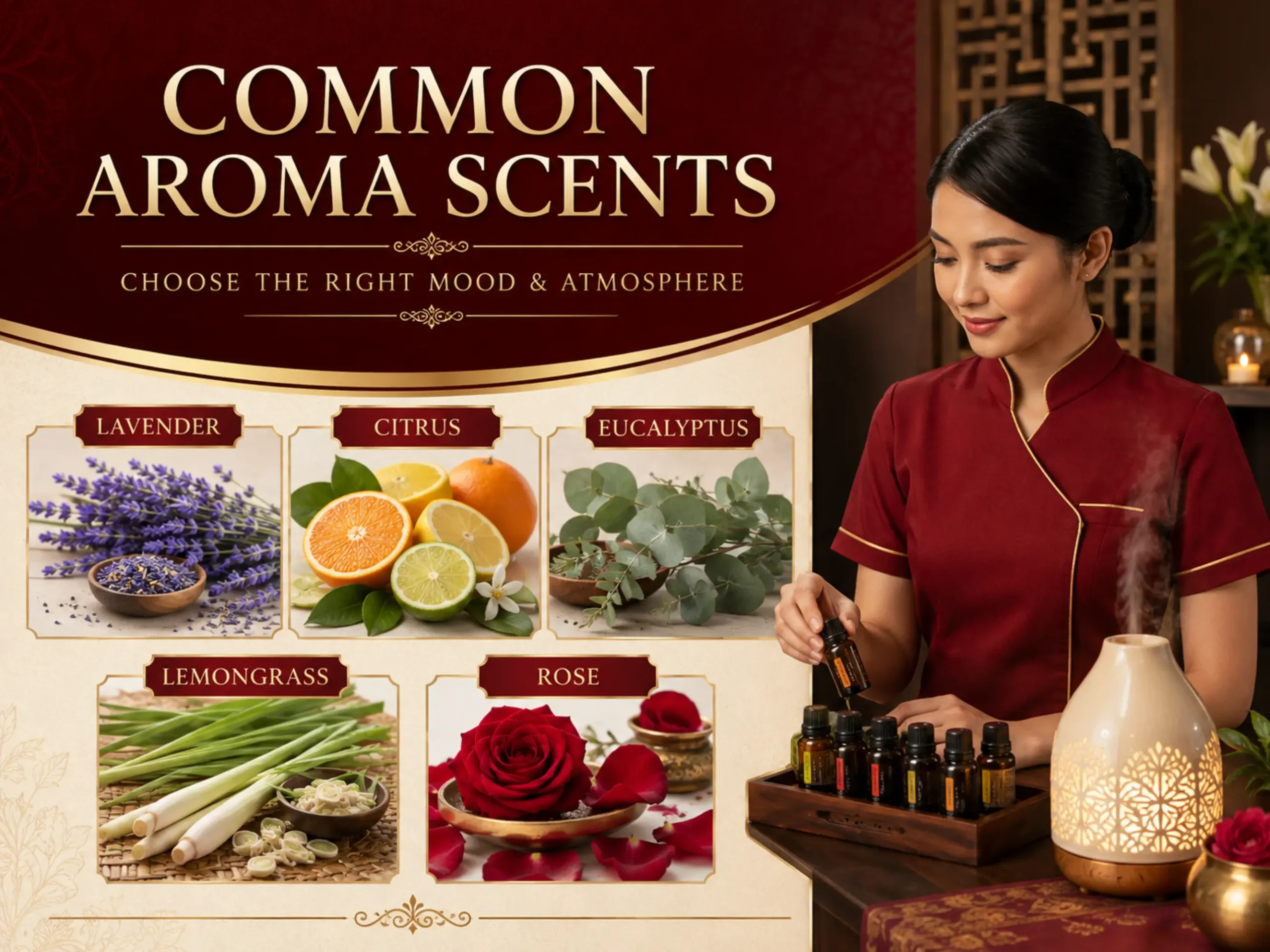
Aroma scents help shape the atmosphere of massage, but no single scent is suitable for everyone. How a scent feels depends on personal preference, sensitivity to fragrance, skin condition, session length, and room size. This article compares 5 common aroma scents in a table format to make the choice easier, without claiming that any scent can directly treat diseases or health conditions.
Quick summary: Lavender is suitable for those who prefer a soft scent. Citrus feels fresh and airy. Lemongrass has a distinct herbal scent. Eucalyptus and peppermint feel cooling but can be quite strong. People who are sensitive to scents or have easily irritated skin should choose fragrance-free oil.
Comparison Table: 5 Common Aroma Scents
| Scent | Scent Profile | General Intensity | Atmosphere It May Suit | Precautions |
|---|---|---|---|---|
| Lavender | Soft floral scent with a slight herbal note | Mild–moderate | Evening, before bedtime, or rooms that need a calm atmosphere | May not suit people who are sensitive to floral scents, have sensitive skin, or get headaches from fragrance |
| Citrus | Fresh, tangy, airy, and not overly sweet | Mild–moderate | Daytime, after travel, or for people who prefer a refreshing scent | Some citrus oils may require caution with sun exposure |
| Lemongrass | Fresh, sharp Thai herbal scent with a citrus-like note | Moderate–fairly strong | Daytime, after walking around, or for people who like herbal scents | May be too strong for people sensitive to scents and may irritate the skin |
| Eucalyptus | Cool, fresh, and distinct herbal scent | Fairly strong | Well-ventilated rooms, daytime use, or as a secondary scent | May irritate the skin or eyes, or feel uncomfortable in closed rooms |
| Peppermint | Cool, sharp, and clearly menthol-like | Strong | Daytime or for people who enjoy a cooling sensation | May cause stinging, irritation, or trigger headaches in some people |
The intensity levels are only general guidelines. The actual scent depends on the formula, concentration, amount used, carrier oil, room size, and ventilation. It should not be assumed that every product with the same scent will feel the same.
Table: Choosing Aroma Scents by Time and Atmosphere
| Time or Situation | Scent That May Suit | Atmosphere Reason | Alternative When Unsure |
|---|---|---|---|
| Before bedtime | Lavender or a mild-scent formula | The scent is often soft and not too sharp for many people | Fragrance-free oil |
| After walking around | Citrus or lemongrass | Gives a fresh and airy feeling | Mild citrus formula |
| After travel | Mild citrus or lavender | Choose based on whether you want a refreshing or relaxing atmosphere | Unscented oil |
| Daytime | Citrus, lemongrass, or a mild eucalyptus formula | The scent is fairly clear and not overly sweet | Reduce the intensity |
| Small room | Mild lavender or mild citrus | Helps reduce the chance of the scent building up and becoming too strong | Fragrance-free |
| 90–120 minute massage | Mild scent or no scent | Long exposure to fragrance may make the scent feel stronger over time | Start with the mildest scent |
| People sensitive to scents or with migraines | Do not choose based on claims such as “helps with migraines” | Some scents may trigger symptoms | Fragrance-free |
This table is not a fixed rule. The best scent is the one that feels comfortable for the receiver, does not cause headaches, nausea, coughing, or skin irritation, and does not have to be selected at all if the main goal is only the technique of aromatherapy massage.
Table: Choosing Aroma Intensity
| Scent Intensity | Suitable For | Benefit | Precautions |
|---|---|---|---|
| Mild | Beginners, people sensitive to scents, small rooms, and long sessions | Reduces the chance of the scent becoming bothersome during prolonged exposure | Allergic reactions or irritation can still occur |
| Moderate | People who are familiar with scents and want a noticeable fragrance | Creates a clear atmosphere without needing a very strong scent | Ventilation and session length should be considered |
| Strong | People who have already tried the scent and genuinely like it | Provides a clear scent within a short time | May increase the chance of headaches, nausea, coughing, or irritation |
A stronger scent does not mean greater benefits, and scent intensity should not be increased in the hope of a therapeutic effect. People who have never used that scent before should start with a mild level and inform the therapist immediately if they feel uncomfortable.
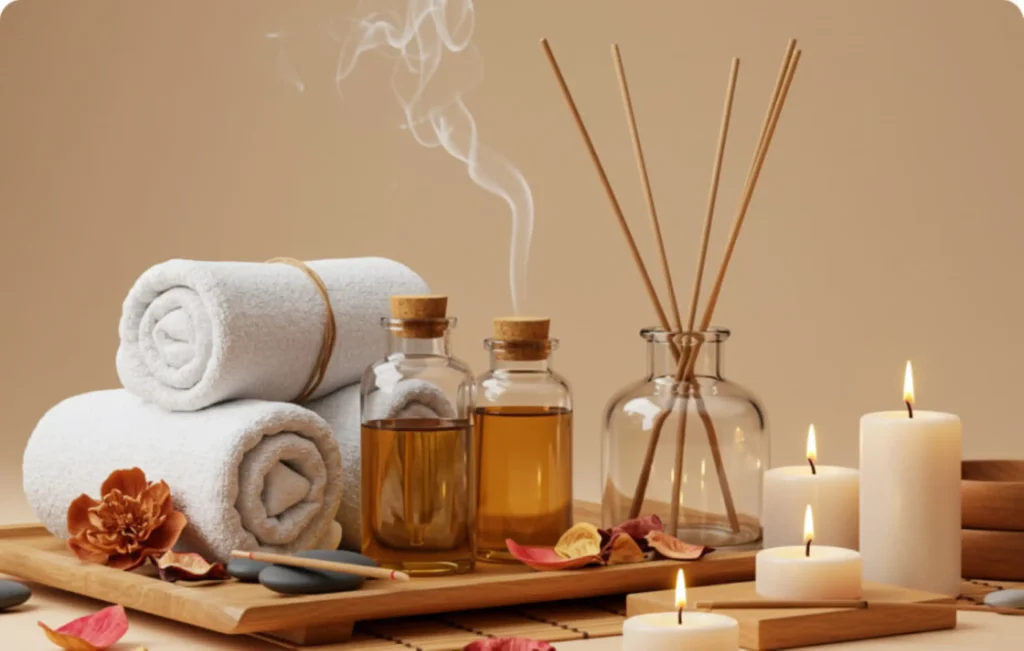
Table: Choosing Aroma Scents by Time and Atmosphere
| Time or Situation | Scent That May Suit | Atmosphere Reason | Alternative When Unsure |
|---|---|---|---|
| Before bedtime | Lavender or a mild-scent formula | The scent is often soft and not too sharp for many people | Fragrance-free oil |
| After walking around | Citrus or lemongrass | Gives a fresh and airy feeling | Mild citrus formula |
| After travel | Mild citrus or lavender | Choose based on whether you want a refreshing or relaxing atmosphere | Unscented oil |
| Daytime | Citrus, lemongrass, or a mild eucalyptus formula | The scent is fairly clear and not overly sweet | Reduce the intensity |
| Small room | Mild lavender or mild citrus | Helps reduce the chance of the scent building up and becoming too strong | Fragrance-free |
| 90–120 minute massage | Mild scent or no scent | Long exposure to fragrance may make the scent feel stronger over time | Start with the mildest scent |
| People sensitive to scents or with migraines | Do not choose based on claims such as “helps with migraines” | Some scents may trigger symptoms | Fragrance-free |
This table is not a fixed rule. The best scent is the one that feels comfortable for the receiver, does not cause headaches, nausea, coughing, or skin irritation, and does not have to be selected at all if the main goal is only the technique of aromatherapy massage.
Table: Choosing Aroma Intensity
| Scent Intensity | Suitable For | Benefit | Precautions |
|---|---|---|---|
| Mild | Beginners, people sensitive to scents, small rooms, and long sessions | Reduces the chance of the scent becoming bothersome during prolonged exposure | Allergic reactions or irritation can still occur |
| Moderate | People who are familiar with scents and want a noticeable fragrance | Creates a clear atmosphere without needing a very strong scent | Ventilation and session length should be considered |
| Strong | People who have already tried the scent and genuinely like it | Provides a clear scent within a short time | May increase the chance of headaches, nausea, coughing, or irritation |
A stronger scent does not mean greater benefits, and scent intensity should not be increased in the hope of a therapeutic effect. People who have never used that scent before should start with a mild level and inform the therapist immediately if they feel uncomfortable.
How to Choose an Aroma Scent in 5 Steps
- Choose the atmosphere you want, such as soft, refreshing, herbal, cooling, or no scent.
- Smell it first using a test strip or from an appropriate distance. Avoid inhaling too close to the nose.
- Start with a mild scent, because the fragrance may feel stronger when applied over the body and used in a closed room for a long time.
- Check the ingredients, including essential oils, fragrance, carrier oil, and your own allergy history.
- Choose fragrance-free when unsure, because you can still receive the technique of oil massage without adding fragrance.
You should not choose a scent only because it is advertised as treating insomnia, detoxing the body, opening the lungs, boosting immunity, treating migraines, or making pain disappear. These claims go beyond the available evidence. Scents should be used only to support the atmosphere and personal comfort.
Table: Choosing Aroma Scents for Outcall Massage
| Room or Setting | Recommended Choice | Reason |
|---|---|---|
| Small hotel room or condo | Mild scent or fragrance-free | Helps reduce fragrance buildup in an enclosed space |
| Windows cannot be opened | Avoid eucalyptus, peppermint, or strong lemongrass formulas | The scent may become too noticeable or uncomfortable when ventilation is poor |
| A roommate or companion is sensitive to scents | Choose fragrance-free | The scent may affect others even if the receiver feels comfortable |
| Two people receiving massage together | Lower the intensity | Using two sets of oil may make the combined scent stronger |
| You need to sleep in the same room afterward | Mild lavender or unscented oil | Helps reduce the chance of lingering scent disturbing rest |
| You have never used that product before | Start with a simple formula and mild scent | Helps reduce complexity if irritation occurs |
Before booking, ask which scents are available, what type of carrier oil is used, whether the product is already diluted for skin use, and whether it can be changed to unscented oil. If you want service at your accommodation, you can view aromatherapy massage and how to book outcall massage.
How Should You Take Care of Yourself After Aromatherapy Massage?
- Use a clean towel to blot excess oil without rubbing the skin harshly.
- Shower whenever comfortable. There is no fixed waiting time before showering.
- If itching, stinging, burning, or a rash occurs, wash the product off immediately.
- Avoid very hot water, scrubbing, and strongly scented products when the skin is irritated.
- Ask about sun exposure precautions when using citrus products.
- Observe your skin on the same day and the next day, because allergic rashes may appear later.
Summary: Which Aroma Scent Should You Choose?
| Preference or Limitation | Option That May Suit |
|---|---|
| You like soft floral scents and receive the service in the evening | Mild lavender formula |
| You like a fresh, airy, and not overly sweet scent | Citrus |
| You like a clear Thai herbal scent | Lemongrass |
| You like a cooling scent and the room has good ventilation | Mild eucalyptus or peppermint formula |
| You are sensitive to scents, have migraines, or have easily irritated skin | Fragrance-free |
| You have never used the product before | Simple formula, mild scent, and test first |
The best scent is not the one advertised as having the most benefits. It is the scent that feels comfortable, does not cause headaches, does not irritate the skin, and suits the room, session length, and other people sharing the space. If you are unsure, choosing fragrance-free oil is a straightforward option that can reduce scent-related risks.
Frequently Asked Questions
Which aroma scent is suitable before bedtime?
Which scent is suitable after walking around?
Which aroma scent is the strongest?
What scent should people with migraines choose?
Can natural oils cause allergies?
Can essential oils be applied directly to the skin?
Is a stronger scent better than a mild scent?
What should I do if my skin feels itchy after massage?
Note: This article provides general information about choosing scents for massage services. It is not a substitute for medical diagnosis or treatment. People with a history of severe allergies, skin conditions, respiratory conditions, pregnancy, or current medication use should inform the service provider and consult a healthcare professional when necessary.
แหล่งอ้างอิง
- National Center for Complementary and Integrative Health. Aromatherapy. NCCIH. https://www.nccih.nih.gov/health/aromatherapy
- National Center for Complementary and Integrative Health. Lavender. NCCIH. https://www.nccih.nih.gov/health/lavender
- American Academy of Dermatology Association. How to Test Skin Care Products. https://www.aad.org/public/everyday-care/skin-care-secrets/prevent-skin-problems/test-skin-care-products
- American Academy of Dermatology Association. How to Choose Products for Sensitive Skin. https://www.aad.org/public/diseases/rosacea/triggers/tips
- DermNet New Zealand. Photocontact Dermatitis. https://dermnetnz.org/topics/photocontact-dermatitis
- DermNet New Zealand. Fragrance Allergy. https://dermnetnz.org/topics/fragrance-allergy
- Date
- View
- Comment